Romance Writers Should Revolt
Romance is publishing’s most innovative genre, yet our infrastructure is still operating like it’s 1925. We're burning out trying to master a craft no one teaches, and our community is retreating to the shadows. It’s time for a revolution.
You know how one day you write yourself into a corner and you start down a rabbit hole of pursuing solid romance writing advice, and you find none, and you get so frustrated that you feel this overwhelming urge to understand—really understand, just this once—why there is none?
And you end up doing a year of research, and then another, and you branch off into a truly irritating number of tangents, and get sidetracked by esoteric literary theory dickery, and lose your mind and your sleep but you still have trouble articulating the problem, because in typical romance fashion it goes so much deeper than you thought it could?
Long story short, I believe something’s very wrong with the foundations of romance writing education: what we teach, how we teach it, and why, despite our collective good intentions, we’re not getting better at protecting new writers from making old mistakes.
And while I’d love to start a revolution that doesn’t carry this depressing whiff of eau de broken education system, most of us have no idea just how badly broken that system actually is, and how much we lose by pretending everything is as it should be.
For good and bad and nonsensical reasons, we’ve never developed theoretical craft foundations that actually serve romance writers. That missing foundation has made romance writing weak and dysfunctional on all levels, from the creative to the economic to the personal. Our lack of knowledge about how our genre really works not only makes writing harder, it limits our earning potential and it wrecks our self-confidence. It creates so many sub-problems that I’ve come to think of it as this great big nesting doll of fuckery that breeds confusion and devastation in all areas it touches.
And our writers think it’s their fault.
Enough.
If you’re a romance writer and you’ve ever struggled to find a straightforward answer to how romance really works, or if you’ve quietly thought it's beyond strange how informal, biased and wildly inconsistent our support systems are, or hey, if you’re just wondering where the everloving fuck the community has gone: settle in.
Because from here on out, we’re going to stop pretending everything is fine.
We’ll tackle this in four parts. Parts I-III will diagnose what’s wrong with romance writing education: why it’s broken, how it got broken, and what it’s really costing us. Part IV is where we outline a fix.
- Part I: An Invisible Problem
- Part II: The System We Call Normal
- Part III: The True Cost of Doing Nothing
- Part IV: Fuck It Let’s Fix It
I won’t lie, this piece is long. And problem-heavy. And the world is a burning pile of trash right now and there’s a growing acceptance that it’s half past existential decay for humanity. But if there’s one group of people who believe in hope against all odds, it’s us romance writers.
So let me just pause right here to insist, emphatically, that I refuse to capitulate. I will cling to the notion of HEA well past my dying day, thank you very much. You can claw the ideals of romance from my cold dead hands, but guess what, I’ve read enough of it to know zombies can still get it on.
That is to say, when you come out at the other end of this, I will do my absolute best to ensure you’re leaving with hope, and a giddy sense of anticipation for what’s to come.
Alright. If you're on Team HEA: there’s work to do. Fucks to give. Revolutions to start.
Let’s go.
Part I: An Invisible Problem
⚡ ⚡ ⚡
How I became an accidental expert in romance writing advice
As far as clichés go, let’s get the worst of it right out of the way: I wrote my first romance story when I was fourteen years old. Whatever angsty train wreck you are now conjuring in your mind, trust me, it was worse.
I have vague notions of twin sister main characters, because why only have one couple when you can have two? It’ll be twice as good! (It wasn’t.)
The first sister’s love interest bore an uncanny resemblance to a boy I was too shy to talk to in class, and, much like said boy, had absolutely no personality to speak of. (In all fairness, it’s not like he needed one, since there wasn’t a single line of dialogue in the first half of the story.)
A cruel detail that has stuck with me: the characters’ names were Rain and Jace and Pace, which, at the time, seemed perfectly reasonable, if not downright inspired.
As for who the second sister fell in love with, I mercifully don’t remember, but let’s not kid ourselves. Odds are she ended up with her sister’s boyfriend’s twin brother.
Whose name was probably Dane. Or Zane. 🫠
Reader, I was not a romance writing wunderkind.
Some of my stories have suffered from minor flaws, others from absolutely fatal blows—and not the sexy kind. At various points, my stories exhibited a lack of: chemistry, conflict, payoff, plot, tension, dialogue, description, voice, and (rather appallingly) romance.
Name the mistake, I’ve made them all. Repeatedly. And then I’d get stuck, every single time, because I’m constitutionally incapable of Just Moving On when something I write doesn’t work as well as I want it to. I need to understand exactly why it failed and how to fix it.
✨ F-o-r-e-v-e-r ✨
When you make every possible mistake combined with that kind of relentless need to figure things out, you’ll eventually start to notice that there’s no real path to improvement, and that nobody can give you real answers. And so the irony we’re working towards here is that my many and varied failures taught me to spot the same gaps and problems and limitations in the advice I was consuming.
Slowly, those decades of getting absolutely everything wrong about romance writing turned me into an accidental expert on romance writing advice.
And what I’m seeing infuriates me.
We treat a systemic problem as individual failure
I can’t pinpoint when my quaint little quest to become a decent romance writer turned into full-blown suspicion at why things are like this:
Why is it so difficult, and why does it take so much time to become a good romance writer, let alone a great one? Why does so much of the advice that’s out there feel so vague and unhelpful? And why are romance writers throwing out caveat after caveat: this has worked for me, it might not work for you; I kind of approach it like this, but what do I know; I’m not an expert, but...
The deeper you look into romance writers' accounts of their learning experiences, the less sense it makes that there isn’t a solid body of craft guidance built specifically for the genre. Most formal writing programs ignore romance entirely, and what advice does exist outside of them leans on rigid formulas or beat structures that manage to be very prescriptive and very nebulous at the same time.
New and established romance writers alike end up piecing together their education from blog posts, social media threads, critique partners, workshops, conventions and peer communities, where the advice is generous but highly variable in quality. The effect is paradoxical: a community that’s incredibly supportive but also deeply insecure, where we’re lifting each other up while secretly wondering if we can really tell brilliance from bullshit.
Imposter syndrome among experienced, successful writers runs rampant:
Am I qualified to talk about writing erotic scenes in SF/F? I mean, yeah, I do write those scenes, and readers seem to enjoy them, and I’ve written nine books, but there is probably someone better who could talk about it.Romantic fantasy and SF writer Jessie Mihalik, Blog (2023) — Source
Rachel Burton, author of The Pieces of You and Me, said: ‘As I hand in book 4, I still feel as though I have no idea what I’m doing, and am surprised that I’ve written another book in an industry where I feel everyone knows more and is doing better than me.’Phoebe Morgan, Blog (2019) — Source
It’s so easy to pass off this kind of hedging as individual self-doubt. For decades, I was certain that romance writing being so unbelievably foggy was simply a me-problem.
But when the pattern is this consistent and this widely observable, when even romance writers at the height of commercial success can tell you what works but not why, craft insecurity is clearly not about individual failure.
Something else is going on.
⚡ ⚡ ⚡
Talking about profound failures in romance writing education seems like an odd choice when literally everywhere you look, our writers are celebrating incredible successes. We have legions of writers who have figured out romance writing for themselves. They know their craft. They have worked hard for it. I don’t want us to mistake critiquing how romance writers learn for a critique of romance writers themselves.
But what often gets lost is that individual success doesn’t prove systematic success. When talented, determined people succeed despite inadequate instruction, their success obscures that there’s a problem in the first place. It creates the illusion that nothing needs fixing, because there’s ample proof that the system can work for some people.
Having knowledgeable writers and having a knowledge system are two different things. When know-how lives only in individual writers’ heads, every new writer has to rediscover it independently. The whole point of codifying knowledge is so the next person can start where you left off. Each generation should be more capable than the last, not because people are smarter, but because they’re building on a higher foundation. Real educational infrastructure lets knowledge accumulate and compound. It smoothes the learning curve.
In romance, that’s not happening. We’re all still starting from scratch, rediscovering the same fundamentals in isolation. Our collective knowledge base is built on quicksand. We even treat survival in this system as a rite of passage. If you don’t sink, congratulations, you’ve proven yourself.
I can’t tell you when we dropped the ball on making our craft learnable, but at some point, we did.
Romance writing theory now lags decades behind romance reality. Our stories are more varied than ever: we’ve got unreliable narrators, non-linear timelines, genre-blending experiments, subgenres spawning at breakneck pace, and everyone is going after everyone in every configuration you can imagine. Not to mention the increasingly wondrous shapes and sizes of our equipment.
But while the genre has evolved so dramatically, our advice has not. Our theoretical base has been strangely untouched by time, as if we’re all operating under the assumption that nothing fundamental has happened in romance writing in decades.
Let’s look at that meet-cute. If you’ve ever searched for romance writing advice or wanted to understand how to structure a romance story, you’ll have come across it. Romance writing education often treats it as structural gospel, as a mandatory beat with prescribed timing, typically in the first chapter, or up to the third chapter, or anywhere from 8-10% of the word count, or within the first 10-15k words. Everyone is very sure of it.
Yet the concept itself remains almost entirely unexamined.
If you’re familiar with its history, you’ll know the term meet-cute originated in the 1930s as Hollywood screenwriting jargon for screwball comedies, got imported wholesale into novel instruction, and has since been taught through examples drawn mostly from 1990s rom-coms.
You can see why it has remained popular: it’s got a self-explanatory catchiness to it, and when it works, it works really well. So my beef with it isn’t that it’s a bad concept, not at all. What I want to highlight is that we have so little formal theory that we gave this one vastly more weight than it deserves, and stretched it awkwardly to cover stories and subgenres where nothing ‘cute’ ever occurs.
Writers are routinely told exactly when that meet-cute must happen, but rarely why the scene matters structurally, how it differs from the inciting incident, or whether and when a movie-derived framework even serves prose fiction.
Over the years, many writers have demanded more critical reflection, because guess what, the meet-cute made no structural sense in their stories. Community discourse began to develop alternative concepts like meet-ugly or meet-disaster, which acknowledge the framework’s inadequacy for enemies-to-lovers, dark romance, or arranged marriage stories, in which the first encounter is hostile, transactional, or even traumatic. But much of that critical engagement stops at stating that there’s a problem. It never evolves into actual pedagogy.
This creates a situation that many romance writers will recognise: the received wisdom tells you in no uncertain terms that the meet-cute is a must-have romance component, and that you go against any romance convention ‘at your own peril’, but when you look at your draft, it just doesn’t fit (and not in the fun way).
And so we keep poking, tentatively.
I’m certainly not the first to ask: what about second chance romance? What about friends to lovers? What about throuples and why choose? Writers working in subgenres in which the traditional meet-cute is a nonsensical construct are left to adapt on their own, wondering if by ignoring the advice that all says the same thing, they’re doing it wrong. They receive either silence from craft instruction, or the baffling suggestion that a kidnapping or having known each other since childhood is simply ‘another type’ of meet-cute. Case closed.
This is the part that kills me. Instead of just... naming the concepts that are already in use everywhere, we bend the orthodoxy until it’s unrecognisable. We keep the beat, keep the timing because the timing is apparently fucking sacred, strip the ‘cute’ from it while retaining all its structural assumptions, and nobody seems to notice we’re now using a word that no longer means what it says, in a context that thirty years ago, nobody would have called romance.
There’s certainly an argument to be made that we can be flexible with language, that a label can be a placeholder for a lot of things. Sure. But in doing that, we are actively obscuring the real mechanics of story creation. A meet-cute might rely on building charm and serendipity, an arranged marriage meeting might rely on creating a sense of dread or obligation. Those are fundamentally different craft challenges that require completely different approaches.
We aren’t helping writers by stretching these ill-fitting labels until they basically cover nothing. We’re actively making their process more difficult, and undermine their confidence at the same time.
⚡ ⚡ ⚡
The kindest explanation for this situation is that we’re striving for simplicity, that we’re stripping our knowledge down to its essentials to make it maximally accessible for newer writers. A less kind but probably more accurate take is that there was never much complexity in our education to begin with.
We’re still teaching romance like we did in the 90s, except now with consent. So much of our education remains shaped by old absolutes that no longer represent what’s actually going on in the genre. Somewhere along the way we stopped thinking about romance craft as a thing that can be actively studied and advanced, poked, prodded, amended, and made into a shape that better resembles reality.
It’s really no surprise it’s taking us so long. When the only thing keeping knowledge alive is individual spare-time goodwill, a field will evolve only at glacial pace. And trust me, I feel like a colossal arsehole declaring that our goodwill isn’t cutting it. So, with love and respect and a profound gratitude for every romance writer who so generously shares their craft knowledge today: please don’t stop. Sharing your knowledge and your perspective is vital.
But please, let’s also admit that whatever volunteer craft advice we cobble together out of the kindness of our hearts isn’t a substitute for institutional infrastructure. All that piecemeal knowledge can and should work as a supplement, but it’s catastrophically inadequate when it’s the only means of passing on our skills.
Other genres, backed by academic research and critical traditions, are developing craft principles and frameworks that help writers understand how and why their genres work. Meanwhile, in romance writing, not only are we not putting up a meaningful effort to further our theoretical understanding for the benefit of all our writers, we don’t even have the language to properly articulate what it is we’re missing.
If we see something that works, we resort to reverse-engineering its most identifiable feature (Vampires! Dragons!) instead of teaching what underlying craft mechanics made these stories become popular in the first place. And to be fair to us, what else could we do? Nobody really knows what made them resonate. Romance success factors are being treated as a combination of instinct, luck, timing, and vibes.
In other words: ¯\_(ツ)_/¯
If success is seen largely as random, advice lets itself go. Why develop rigorous craft principles when you’re essentially teaching people how to win the lottery?
I won’t pretend I have easy answers. What makes a romance resonate is impossibly hard to pin down. It exists in that maddening space where objective measurement and subjective experience meet, overlap, and sometimes flat out contradict each other. Success itself is multi-causal, which is to say: a fucking mess. For every half answer you find, five more questions pop up. I’ve been at it for years, and just trying to fully understand the problem feels like untangling the world’s most annoying ball of Christmas lights.
But the solution to a hard problem isn’t simply ignoring it. The vacuum at the centre of our craft means that the stuff we end up teaching is almost comically vague and aspirational. We preach write what you love, or follow your passion, or trust your instincts, because nobody wants to admit they don’t know what separates romance greatness from forgettableness. When our writers are constantly told to ‘build romantic tension’ without learning romance-native techniques for actually doing it, it’s no wonder so many of us learn to rely solely on our instincts.
Romance writing advice, if you’re lucky, tells you what to do. Rarely it will tell you how or why to do it. It often looks good from a distance, but then doesn’t help you actually pull off the effect you’re after.
Let me give you a concrete example to show you what I mean by that. Suppose a writer wants to know:
How do I make my banter feel more flirty instead of friendly? I’m getting friends having coffee vibes when I’m aiming for crackling tension.
Today, that writer doesn’t have access to a well-researched breakdown of banter mechanics in romance. They don’t have access to resources that teach how to craft banter pacing and rhythm; that show how intensity escalation patterns work at scene and at sentence level; or how they can craft layers of subtext that play with what’s said versus what’s meant versus what’s felt. We don’t teach writers how timing and interruption is supposed to come to together, or how they can use intimacy and power plays and sensory details to their advantage. We don’t teach how to write the moment when banter stops being safe and someone accidentally says the true thing. We don’t even have ready answers for why great banter works so well for so many readers in the first place.
But shouldn’t our writers have access to all these things?
I’m not saying we have to stop relying on our instincts or over-engineer stories that actually benefit from occasional craft messiness. I’m for authenticity, not against it. But not at the expense of a writer’s sanity or economic reality. When that writer needs to understand what’s going wrong with their banter to make a deadline, or to meet their own standards for success because they've felt this concept work elsewhere, having a resource that helps them locate the problem and fix it should in theory be a low bar to clear.
We’re not clearing it right now.
Think of all the specific questions that arise so often in romance writing, and that aren’t being answered in exactly the same way. What makes my instalove trope feel destined rather than ridiculous? What signals that my character is actually hurting when their persona is an absolute fortress? Did I cross the line between sexy pursuit and creepy pursuit?
Or let’s talk chemistry, that mysterious force every romance writer chases but nobody can properly explain. When readers say ‘there’s no chemistry,’ we throw in more smut, or have characters announce how hot they find each other—not because that’s necessarily what’s missing, but because nobody’s ever come up with a framework that unites specific, learnable techniques into a workable blueprint that helps you build chemistry step by step.
This technical gap exists everywhere you look in romance.
Nobody teaches us why some sex scenes feel transcendent in your bones while others read like IKEA furniture assembly instructions. Both describe identical acts. What makes the difference? Why are some compliments utterly devastating in their emotional impact, and others feel like a Yelp review of someone’s face? What makes a scene where two people say nothing feel louder than a screaming match in another?
I’m not talking about a few missing writing tips here. There’s an entire craft knowledge ecosystem that doesn't exist. And that’s before you get into the intricacies of our subgenres. Once you start noticing how weird it is that our advice generally doesn’t feature theoretical depth or examples that show you how craft principles work on the actual page, you will never not notice it again.
You will notice how everyone constantly twists themselves into pretzels trying to adhere to supposedly universal unwritten rules that no one can actually articulate. Like how ‘ideal’ MMCs have to be assertive but vulnerable, dominant but not controlling, respectful but in definite pursuit? In case you were wondering, that’s not actionable craft instruction. Advice like that doesn’t come from a time where that MMC might be a moth.
And yet, many of us figure enough of it out eventually. Many of us have instincts sharper than knives. But when you’re trying to make writing financially sustainable, or hey, when you spend your limited free time writing for your own emotional catharsis, just keep doing it until you figure it out isn’t practical or healthy advice, even if it’s true and even if you manage in the end, somehow. Some writers can afford years of that kind of trial and error. Most can’t.
Either way, why don’t we simply give everyone the choice?
⚡ ⚡ ⚡
You could point out that the choice exists, and I wouldn’t even categorically disagree. There are moments of brilliance in our writing advice, moments that show just how much craft knowledge really rests in romance writers. Those moments are there, and I’m looking directly at all you Substacking romance advocates out there. But without a system to preserve and build on these insights, they vanish into the ether long before they can have an impact on writers who need the information next month, and the month after that.
Meanwhile, our newcomers get rerouted with stunning consistency to the same handful of basic resources that are supposed to teach everyone the deeper mechanics of romance story construction, whether you’re a Shifter romance writer, an M/M space cowboy writer, or a romantic suspense writer.
Spoiler alert: they can’t.
Take the wonderful Romancing The Beat. It can be downright revelatory for a newer writer to find a system that for once tracks the emotional happenings of a story instead of its external beats. But wow, has that one single resource done a lot of heavy lifting over the last decade. Why aren’t there dozens more like it by now? Because romance just isn’t that complex?
I’m begging you.
For some reason, we’ve settled for do the simplest thing that’s proven to work as a baseline, and convinced ourselves that we must fill in all the remaining gaps ourselves. I know you’ve seen and felt those gaps in our knowledge, the gaps that are really craters. And I bet that you’ve ignored the steady drip drip drip of suspicion at why things are like this, just like I did.
Here’s the deal though.
It is wildly improbable that good romance writing being so hard to achieve is an individual problem. We can’t all be idiots.
So then, when we’re all face-planting into the same expected pot holes on our journey to becoming great romance writers, isn’t it time to stop blaming our collective walking skills, and start asking what asshole built a road like this?
This is not a you-problem or a me-problem. Our advice isn’t just inconsistent for us. It’s consistently inconsistent—across different writers, styles, subgenres, platforms, formats, generations. It’s a pattern of potholes, baked into the path of every romance writer who has ever wondered how the hell to do this thing well.
What I want us to understand is that this pattern isn’t random. It follows some kind of order. As we will see, it’s just not ours. In the next part of this piece I’m going to show you that our problem goes far beyond a few missing blog posts. We’re up against forces that actively prevent us from building, maintaining and sharing collective knowledge, and it’s screwing every single romance writer out there.
Our lack of accessible, romance-centred resources prohibits us not just from meaningfully advancing our understanding of our craft, it keeps us from evolving the entire art form, making innovation accidental instead of an intentional goal.
How the hell did we get here?
Part II: The System We Call Normal
⚡ ⚡ ⚡
To get an understanding of the entire broken system around us, we’ve got to name the players who keep it rigged. I want to change gears for a bit and talk about how and why romance is locked in a perpetual state of illegitimacy.
Some of this will be about familiar actors running familiar, tired playbooks. But we’re also going to trace something that most romance writers don't realise: just how much we ourselves contribute to keeping the status quo unchanged.
Defending romance legitimacy steals our resource bandwidth
If we want to figure out where theoretical thinking about the romance genre originates, our path leads us straight to academia.
Not the sexy, dark kind of academia, unfortunately.
When it works as it should, academic attention turns scattered observations about writing into teachable frameworks and principles. Scholars identify patterns across hundreds of texts and create precise language to describe techniques.
In romance, it doesn’t work that way. While there are hopeful signs that romance is finally being studied and debated unapologetically in some scholarly circles, compared to other genres, our academic theory output remains vastly disproportional to our story output. As any romance scholar will tell you, this isn’t because the genre somehow repels or resists theoretical reflection. It’s—surprise!—the predictable result of decades of deliberate exclusion from academic and critical spaces.
 webmanager
And I know this takes us into the well-trodden and tedious territory of defending romance in the face of near-universal dismissal, but it’s important to understand that this academic exile doesn’t just surface level insult us. It structurally prevented us from developing the theoretical tools other genres take for granted, and it still deeply sabotages our craft education today. So let’s take a closer look at romance's role in traditional academia, and let’s start by dismantling the ridiculous notion that romance is somehow worth less than other literature.
For well over a century, people in academia have systematically dismissed romance as hysterical and frivolous and oversexed and not worthy of serious literary study. The contempt ran so deep that when literary value metrics were being developed, they were built expressly to exclude romance’s core ideas.
Throughout the defining decades of literary theory, as movement after movement debated what should make a story worthy, people with dominant cultural authority promoted their own narrow, biased, hierarchical views of literary excellence. They fetishised emotional distance and ironic detachment, and dismissed feelings as feminine weakness. They saw ambiguity as intellectually superior, and uplifting endings as asinine wish-fulfilment. They declared sparse prose to be desirable, and flowery prose to be degenerate and obscene.
Romance, by default, is guilty of every literary crime they invented.
When you design a test around certain features, you guarantee the results. If your scoring system rewards emotional distance, uncertainty, and bleak outcomes, then obviously a genre that prioritises closeness, clarity, and earned optimism will always bomb the test, no matter how well it does what it set out to do. The result is not proof that romance lacks literary or craft value; it’s just proof the test was rigged from the start.
At the risk of being too direct here, it’s like you're evaluating a tampon on how well it works as a microphone. You’re not proving tampons are useless, you’re just demonstrating that you don’t understand what tampons are for, darling.
And how could you?
The people who set these rules didn’t read romance widely. Most of them didn’t read it at all, and still don’t. And look, I can’t tell you where the line is for how many romance stories one should have read before making an informed judgment call about its literary value as a genre, but I’d hazard at the lower end, it’s in the triple digits? Give us a call when you’ve made it that far, and we’ll suggest a subgenre, or two, or ten, that you missed.
Then we’ll talk.
⚡ ⚡ ⚡
What rarely gets said out loud in this context is that this game was fixed so long ago that, for the better part of a century, we’ve literally educated everyone not to see what romance does best. The current metrics we use to examine what makes a story great don’t just fail to measure romance’s value—they actively blind us to the very techniques that make romance effective as a genre. When you systematically dismiss intimacy, you don’t build the skill set to analyse how it functions as a craft technique. Those muscles will only come from exercise.
This isn’t speculation. Detective novels began to gain scholarly legitimacy in the 1930s and 40s, science fiction had sustained intellectual and academic defenders from the 1960s. Scholarly attention eventually translated into cultural legitimacy and awards, which translated into formal education and craft infrastructure. More recently, fantasy has begun to take the same path. Over time, people simply forget they were convinced it’s all trash.
I don’t know about you, but observable, predictable, institutionally reinforced ignorance on that scale makes me urgently question the traditional metrics for detecting literary value. Not engaging with a genre in good faith until the evidence crushes you is not just epistemically weak, it is a failure of intellectual responsibility. And I don’t mean to get existential about it, but think about where writing advice comes from and how many of these systemic, baked-in biases and blind spots it carelessly replicates.
And yet we're all going merrily about our ways, trashing romance.
At this point, you could reasonably be asking yourself why so few academics are operating from the intellectually coherent point of view that our literary value system is based on bias and opinions, not objective fact.
The answer is that academia isn’t designed to question its own foundations. The logic is beautifully circular: universities teach what they’ve always taught, which proves it’s worth teaching. Influence—grant money, scholarship money, prize money—flows in the direction of whatever reinforces and validates the established structures and viewpoints.
What keeps careers on track is being comically, irrationally invested in putting distance between romance and ‘real’ literature. Since the dawn of romance writing, people with cultural power have exerted deranged amounts of psychological pressure to make everyone accept the premise that romance is lesser. The system doesn’t just passively exclude and ignore; it teaches shame. Actively. Institutionally.
Turns out feelings are scary business.
And so it will come as little surprise that even a hint of a romance connection is toxic to academic careers, as if the mere association to it is enough to call into question your intellect. Shakespeare scholar Mary Bly explains the calculation many romance writers in academia have to make:
I did not come out as Eloisa James until I had tenure and I’d hit the New York Times best-seller list. People magazine wanted a picture of me to run with a review of my second book. The chair of the English department said, ‘You will not get tenure. You will destroy your career.’Rachel Kramer Bussel interviewing Mary Bly, Vulture (2014) — Source
That same toxic environment hounds romance scholars. Like in many other areas of romance story production, the small world of romance academia happens to be a field largely populated by women scholars.
Regrettably, much of the academy still labours under the delusion that a penis is the required instrument for detecting literary value. The male romance scholar Eric Murphy Selinger notes:
not once have I faced the kind of scrutiny or the kinds of questions or the kind of resistance that you know, many, many, many of my friends and colleagues have faced. Like I said, since 2005, half of my courses have been on romance novels. I don’t know anybody else. Literally, I don’t know anybody else, anyone in the world, who's had that kind of opportunityEric Murphy Selinger, Shelf Love Podcast Ep. 063 (2020) — Source
But of course, should a man elect to study romance, that most undignified and moist of literary preoccupations, we shall trust his noble mind to remain unmoved by these deplorable corruptions. By Jove, he is a man of reason! He shall not be ensnared by these wretched frivolities! Though he remains an oddity, does he not; wanting to investigate that which is best left to the emotionally incontinent classes. Shall we observe him, bemused, from a dignified distance, and at every opportune moment ask him to defend the entire endeavour aloud?
Academia can be pretty grim. It’s worse by orders of magnitude when it’s romance academia you’re interested in, and worse still when you have the audacity to be a woman with a brain.
But here’s what romance defenders often skip over: this lack of prestige isn’t just cosmetic, and caring about it isn’t just an exercise in pointing out misogyny. When you follow it all the way to the end, delegitimising romance leads straight to a lack of craft infrastructure.
⚡ ⚡ ⚡
It won’t come as a huge surprise that popular romance studies as an academic field is very young.
Detective fiction had dedicated scholarly journals by the late 1950s; romance didn’t get comparable infrastructure until 2010.
Importantly, the scholarship that does exist today emerged not from an interest in craft, but largely from ideological critique. Scholars weren’t asking how these texts work as narratives, they wanted to know why readers seemingly can’t get enough of romance, how it reflects our society, what it says about our deep-down fantasies, our anxieties. Questions of composition and technique were explicitly set aside as beside the point.
This origin story matters enormously in our context: we’ve inherited a scholarly tradition built to decode what romance fiction says about women, not to understand how it actually works as narrative art.
And while I believe that it’s only a matter of time until our scholars set everyone straight, time moves too fucking slowly, and they’re still busy cleaning up a lot of garbage opinions.
By necessity, romance scholarship today operates within the confines of what’s seen as acceptable, not for literature, but for romance. Current research questions tend to focus on what’s academically legible and fundable when everybody agrees that the text itself is shit: gender and identity, social anxieties, consumer culture. Anything that lets you talk about its noteworthiness without implying that the text is, in fact, literature.
More scholarly attention on the genre is great, of course it is. But it doesn’t mean we’re getting the kind of attention that centres craft the way other genres do. At best, craft explorations are a side effect of the romance research that’s currently happening.
If you so happen to leisurely peruse the current Topics of Interest at the Journal of Popular Romance Studies (JPRS), as we all do, you’ll notice how the focus is squarely on cultural analysis and on what romance means, not on how it’s made.
 Laura Vivanco
Want to keep up with what romance academics are currently up to? This is the place to go.
 Andrea Martucci
Romance scholarship reads as recommended by scholars. If you're overwhelmed by choice, this is a really good place to start.
Framing romance within cultural or ideological questions yields valuable and long overdue insights. And I wouldn’t accuse anybody who is studying romance of intentionally delegitimising craft. These are smart people. But if they continually get nudged elsewhere because their careers demand it, the overall effect is the same, isn’t it?
Academic study doesn’t just describe craft sophistication, it actively creates it. Genres that were allowed (grudgingly, kicking and screaming) into the university earlier—SF, mystery, crime—now have decades of accumulated craft vocabulary to draw on. That kind of knowledge can’t grow if we don’t start treating romance craft as something that’s worth studying in and of itself.
But we’re not there yet. I can feel the antinomy in you as a reader, the wanting to agree with me while simultaneously suppressing the urge to throw your growing mountain of trainwreck DNFs at me. They are so bad, you want to scream.
I get it, I really do.
Yes, some romance is bad. But ‘bad’ is doing a lot of work in that sentence, and we’re rarely precise about what we mean. Large or small scale craft failure? Accessible prose doing exactly what the writer wants it to do? Characterisations with the wrong amount of emotional containment? Conventions we don't enjoy? A matter of taste? Romance has so many failure modes, and not all of them are about bad writing. We flatten these distinctions because we've been taught the genre doesn't merit finer thinking.
There’s a huge mismatch now between what our writers are being taught and what our readers expect. Writers are doing exactly what the advice tells them to do. They’re hitting their beats, they’re raising the stakes into oblivion, they’re putting the dark moment where the dark moment goes. And then we end up with these stories that feel mechanically correct but emotionally inert. Or sometimes it’s the reverse—we get stories that feel emotionally true but fall apart structurally, because the kind of structure the story actually needs doesn’t exist in any of the advice that’s available to us.
What people get wrong about this is that neither of these cases is a talent problem. It’s a teaching problem. When our advice says ‘put the dark moment here’ but never explains what a dark moment is actually doing, we end up building something that looks like a house but doesn’t feel like a home. Readers can feel something’s wrong, even when they can’t name it. What they reach for is ‘this is bad,’ because we’ve never given ourselves a better vocabulary for what’s actually going on.
Romance writing isn’t the problem here. Romance teaching is.
But it’s not the only problem. Because if we zoom out, even if we genuinely like what we read, we measure romance by how well it works as literary fiction, not by how well it works as romance. And so we perpetuate the biases we’ve been taught. We hedge, we dismiss, we qualify. Readers and writers and scholars want to be abundantly clear that it’s not Shakespeare, right? Even when it genuinely moves us.
Studying romance in good faith today too often means tacitly accepting the premise that it is lesser.
The good news? Some of us are done with that.
What happens when we stop asking for acceptance
Few developments in romance have been as satisfying to follow as the rise of the romance bookstore, which, let’s be honest, has little to do with mainstream support and everything to do with personal determination and creating DIY infrastructure to serve vast overlooked demand.
The Koch sisters, owners of the first romance-only bookstore The Ripped Bodice were ahead of the curve in 2016, and were given the Victorian befuddlement treatment:
The sisters say they’re often asked if they thought their business would be as successful as it is when they launched. ‘Why would I open a business I didn’t think was going to be successful?’ Leah Koch says. ‘If you know anything about publishing or if you've ever spoken to a woman before — why are you so surprised?’Maddie Ellis, Today.com (2024) — Source
Say, but what manner of intellectual poverty would drive one to restrict oneself thus? One genre? It is starvation of the spirit!
Romance bookstores normalise the genre in their communities in ways that academic acceptance never could. But what’s so remarkable about this approach is that it sidesteps the whole legitimacy debate entirely. Romance bookstores don’t argue that romance deserves respect—they simply operate from the assumption that it already does. It’s legitimacy through presence, not persuasion.
According to Romancing the Data, as of December 2025, there are 218 physical romance bookstores globally. That’s a 2000% increase since 2022. And every new one comes with the same game plan: Of course we’ll keep doing this. D'uh.

There’s a directory to explore, there’s a map to plan your road trip, and there are monthly posts with lots of stats. Highly recommend.
This coincides with romance trickling into other mainstream spaces in ways it previously didn’t. Screen adaptations seem to be picking up, popular book clubs now routinely choose romance reads, and, you know, BookTok. More mainstream recognition and more community exposure is good. Hard agree.
But as we’re taking round after round of victory lap celebrating romance’s increasing visibility and popularity and sales, let’s be clear that attention doesn’t equal acceptance. There is a crucial distinction between genuine advancement and elaborate theatre in discussing romance—and right now, we’re getting a lot more of the latter.
The very idea, the distant possibility that a romance writer’s commercial success can stem from the text, that it wasn’t the product of a zeitgeisty, pecs-forward moment but the technical execution that resonated, is simply not entertained in the discourse.
When ‘Fourth Wing’ came out in 2023, it arrived at an ideal moment. BookTok was in the middle of a romantasy craze, and fans quickly coalesced around Yarros.Alexandra Alter, The New York Times (2025) — Source
Success, by default, is treated as out of the writer’s control.
Actually, you know what? That one had dragons. It must have been the dragons. And feminism.
In today’s feminist landscape, dragon riding fiction continues to resonate. For many, the thrill of these stories, especially in the romance genre, is that heroines no longer derive power directly from their relationships with men and in turn they are not seen as subordinate to hero’s goals.Rebecca Scofield, Time.com (2025) — Source
When everyone in the media constantly operates from the assumption that a story’s success is really due to trends, and uncontrollable female urges, and, um, the ‘cultural obsession with women riding powerful beasts’, craft can't evolve—because the process of evolving it hinges, again, on all these players actually buying in to the concept that romance craft exists.
Fourth Wing didn’t succeed on that scale because women suddenly remembered their collective primal urge to strap dragons between their legs. That notion is unhinged. Did it benefit from a ‘moment’? Perhaps. But so do other stories. This one converted because the story was structured like a relentlessly entertaining tennis match, tightly crafted to keep readers volleying between tension and release; had unusually good payoff discipline; had prose optimised for speed and momentum; had consistent voice; and delivered on a dozen other craft-level success factors which were executed reliably and repeatedly. And it’s not just Fourth Wing: you can do this dance with any major romance bestseller. I’ve yet to come across one that was successful in spite of its craft value. Artistically, they all excel at something.
My god, why is that possibility so outlandish?
All this attention on the romance genre is hollow if our craft expertise keeps being ignored and erased and infantilised. Intentionality is rarely acknowledged. The fact that there is a text here constantly disappears behind sweeping diagnoses of market forces, or trending tropes, or reader thirst. Romance dominates the cultural conversation as a curious anthropological spectacle, not as art.
Instead of the openly hostile dynamic we saw in academia, the mainstream one is based on caricature, but it’s just as damaging. In academia, there's a catch-22: they won’t value romance without proof of sophistication, but we can’t prove sophistication without valuing romance.
But in the mainstream, romance’s success is plainly evident, it’s undeniable. So instead of dismissing it as unsuccessful, mainstream discourse dismisses romance as merely successful. The very fact that it’s so popular gets twisted into proof that it must be cheap, easy, and formulaic. The logic goes: readers who enjoy these stories aren’t discerning enough to recognise good literature. All romance stories are the same. They’re the cultural equivalent to junk food.
Together, these dynamics form a perfect trap: in one arena romance is dismissed for failing, in the other it’s dismissed for succeeding.
And perversely, the more it sells, the less seriously anyone studies how it’s written.
Everyone’s faking it
The New York Times has recently begun calling their romance columnist a critic. And while you can certainly roll your eyes at the pettiness and scale of my outrage over that one word, it’s a perfect example of the genre’s performative elevation in the mainstream. We get the appearance of critical legitimacy, but without any investment in actual critical infrastructure.
A critic offers deep analysis by pulling apart a story to trace how and why it works on the page, by situating it within its genre tradition, by mapping its ecosystem of meaning, and by connecting it to facets of the human condition you hadn’t previously considered.
A columnist gives you a summer book shopping list.
Want to take a guess in which category the New York Times operates? Headlines and decks are a Frankensteined combination of Sizzling Summer Romance Novels (Picked By Our Critic).
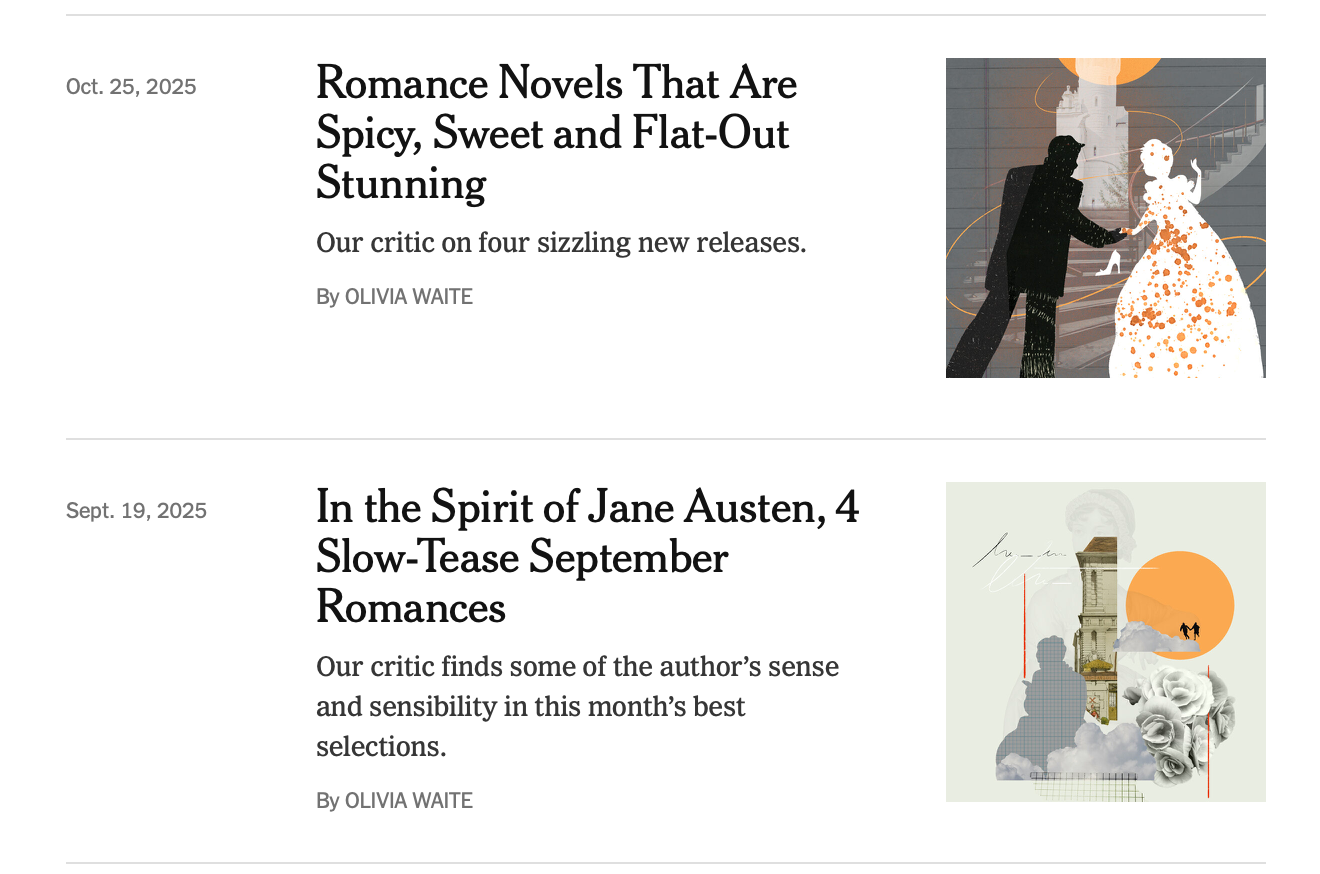
Which: No.
The mislabeling of these articles, whose main substance is a witty summary of three or four book recs, each in roughly 300 words or less, lets them capitalise on romance’s massive readership for clicks while simultaneously maintaining their intellectual distance from it.
(I’m not faulting the supposed critic, by the way. As a columnist, she’s fantastic. She’s demonstrably fantastic as a critic, too, if she were given the space to do it properly. The blame lies squarely with the editor using romance as a disposable traffic subsidy for the stuff nobody buys.)
And we can debate about how consequential the New York Times is to the romance genre—the answer is a hearty not at all—but it serves here merely as a stand-in for the wider Serious Literature ecosystem. I’m embarrassed for them for still delivering this performance.
 Sanjana
In case you need a crisp summary of the mainstream's hypocrisy in this area.
 Rena Rani
Interesting things are happening in romance criticism.
It’s almost funny, in a depressingly bleak sort of way, how consistent that pattern is across the rest of the industry. Whether it’s media or publishing, everyone’s perfectly happy to cash in on romance’s popularity, so long as they don’t have to take it seriously.
Nobody plays that game harder than Amazon.
Through the metrics it has set up, Amazon has ensured that romance, more than any other genre, works in bulk. Algorithms reward rapid releases, KU page-read payments incentivise padding, authors who publish monthly get visibility boosts. Romance writers, who adopted self-publishing faster and more completely than anyone else out of necessity, got trapped in a system where writing faster matters more than writing better.
A carefully crafted romance that took two years to perfect is very likely worth less economically than the hastily assembled story someone else churned out in three weeks. We’ve internalised this to the point that romance writers now apologise for taking six months between releases, as if crafting quality at a pace that doesn’t lead to creative burnout is somehow letting readers down.
And I want to be clear: if you write four or six or twelve or twenty books a year and it works for you, excellent. Speed and quality aren’t mutually exclusive, and I’m not here to shit on anyone’s process, especially when there’s a reader that needed that exact story that day. But we have to acknowledge that this is not a level playing field. Amazon’s infrastructure doesn’t reward rapid release as one viable strategy among many. It rewards it as the strategy. The algorithm doesn’t care whether the story is good, it cares whether it’s recent.
The system isn’t neutral about craft. It actively selects against certain kinds of excellence: the kind that requires time, revision, sitting with a manuscript until you figure out what it’s really about. Writers who need a year, or five, to write something truly distinctive are systematically disadvantaged against writers who can produce serviceable content monthly. Over time, ‘serviceable’ starts to look like the standard.
All this is warping our relationship to craft in ways we’ve stopped questioning, precisely because the system masquerades as democratic. Anyone can publish! Write fast, build that backlist, and readers will find you!
And while that undoubtedly creates opportunities, it also means that only certain kinds of writing, written at certain speeds, by writers with the right life circumstances, can sustainably compete. Everyone else is welcome to try.
And the house always wins.
⚡ ⚡ ⚡
Amazon didn’t invent the idea that romance is disposable entertainment, but it built an entire economic infrastructure that ensures it keeps being true. And it sets the tone for the rest of the industry.
Publishers, who were never exactly generous with support to begin with, have adapted to the new market realities of excessive volume. There are no reliable figures, because publishing operates like the mob when it comes to any kind of industry data. But anecdotally, we can trace a broad and brutal decline of editing, mentorship, and marketing support to keep up with the pace.
And that matters more than it sounds like it does. Because for a lot of romance writers, the editorial relationship was one of the last places where craft actually got transmitted. Through a person who understood the genre and who sat with your manuscript, who showed you why this scene isn’t landing, why the reader is going to lose faith in your FMC at exactly this point if you don’t fix what’s underneath. That kind of knowledge is specific and contextual and accumulated. It doesn’t survive being turned into a listicle.
Editors who used to develop writers are now processing volume. The rise of the editor-agent is a direct response to publishers no longer doing this work at scale, but that only helps writers who have agents, and only if those agents have strong editorial instincts. That last line of defence for craft development in romance is slowly disappearing, and we’re not building anything to replace it.
Some people will want to skewer me for making this connection, but the fanfic space has become the closest thing many writers have to an immediate, iterative feedback loop on their writing, chapter by chapter. It's not editorial mentorship, and it certainly comes with its own biases and distortions, but it can work and it's a form of real-time reader response that writers can find nowhere else for free.
This is where we are.
And then the story gets packaged, which contributes in its own highly choreographed way to the impression that romance craft is irrelevant.
Emily Henry literally has a reputation for dividing readers into shifting camps with every new story, yet her books barely get enough cover differentiation to suggest they’re distinct stories. Of course anyone who isn’t familiar with romance will think these stories are interchangeable. Marketing flattens what’s actually one of her distinguishing features: broad variety in story, tone, characters, themes and emotional core.
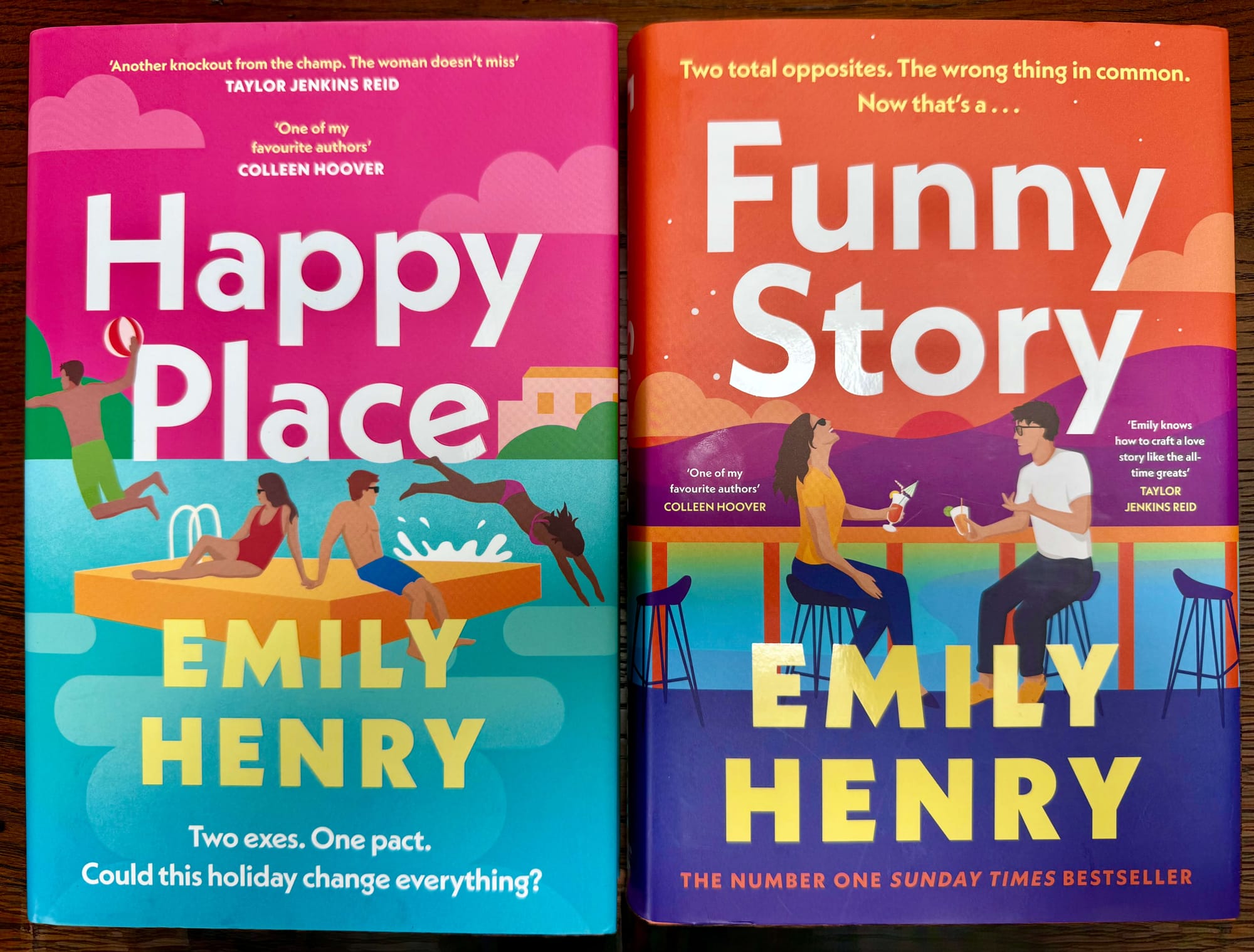
And look. I get that these sell. They look nice lined up on a shelf, too. But the degree to which this happens in romance is another subtle way that we teach readers, academia, the media, critics, and even writers themselves that all these stories are essentially the same thing, that craft in romance is irrelevant, and what truly matters is vibes and volume.
The economics reinforce what the academy established: romance doesn’t require craft sophistication, just formula and output.
What’s so frustrating is that we’ve said all this before.
None of romance’s systemic dismissal is news to us. We’ve known it from the beginning. What you’re reading is just the latest entry in a long, strong tradition of calling out this bullshit. Many of us agree that romance deserves more, and deserves better. I could do this all day.
Which is kind of wild, isn’t it? We've been singing this song for decades now. We point at gatekeepers and critics and distributors and say the problem lies with them. And it does, partly. But if we’re being honest, we’re also not entirely without agency here.
Waiting for external validation is a choice, and we keep choosing it.
There comes a point where we have to ask ourselves: what do we expect to change from naming the problem? Nobody is going to go out of their way for us just because we’re being, you know, logical and intelligent about it. Not when there is resistance and inertia and money to be made at every step of the way.
And if you’re wondering why we haven’t begun that work already, the answer is that we’ve been stuck in our own loop. A loop that takes every external dismissal and turns it inward, until it feels like normal. A loop that takes all our good intentions and turns them into mediocrity.
I call it the Romance Writing Doom Loop.
It is my nemesis.
The normalisation of underachievement
External dismissal doesn’t just hover outside romance, it seeps in. We're slowly marinating ourselves in it, and not in a tasty way. It’s like we’ve soaked up all this garbage from swimming in garbage soup for so long.
You can see it in the advice we trade, in the expectations readers bring to our stories, in the standards to which we hold ourselves. That’s where all the outside biases we just looked at turn into an inside trap.
Like so many other parts of this system, the pattern I’m going to show you here forms a neat circle again, a self-perpetuating cycle.
This is the Romance Writing Doom Loop:
- Our lack of quality resources leads to a difficult writing experience,
- which prompts writers to default to ‘proven’ formulas,
- which lead to shallow stories,
- which lead to low reader expectations,
- which doesn’t make it necessary to improve,
- which leads to a lack of resources.
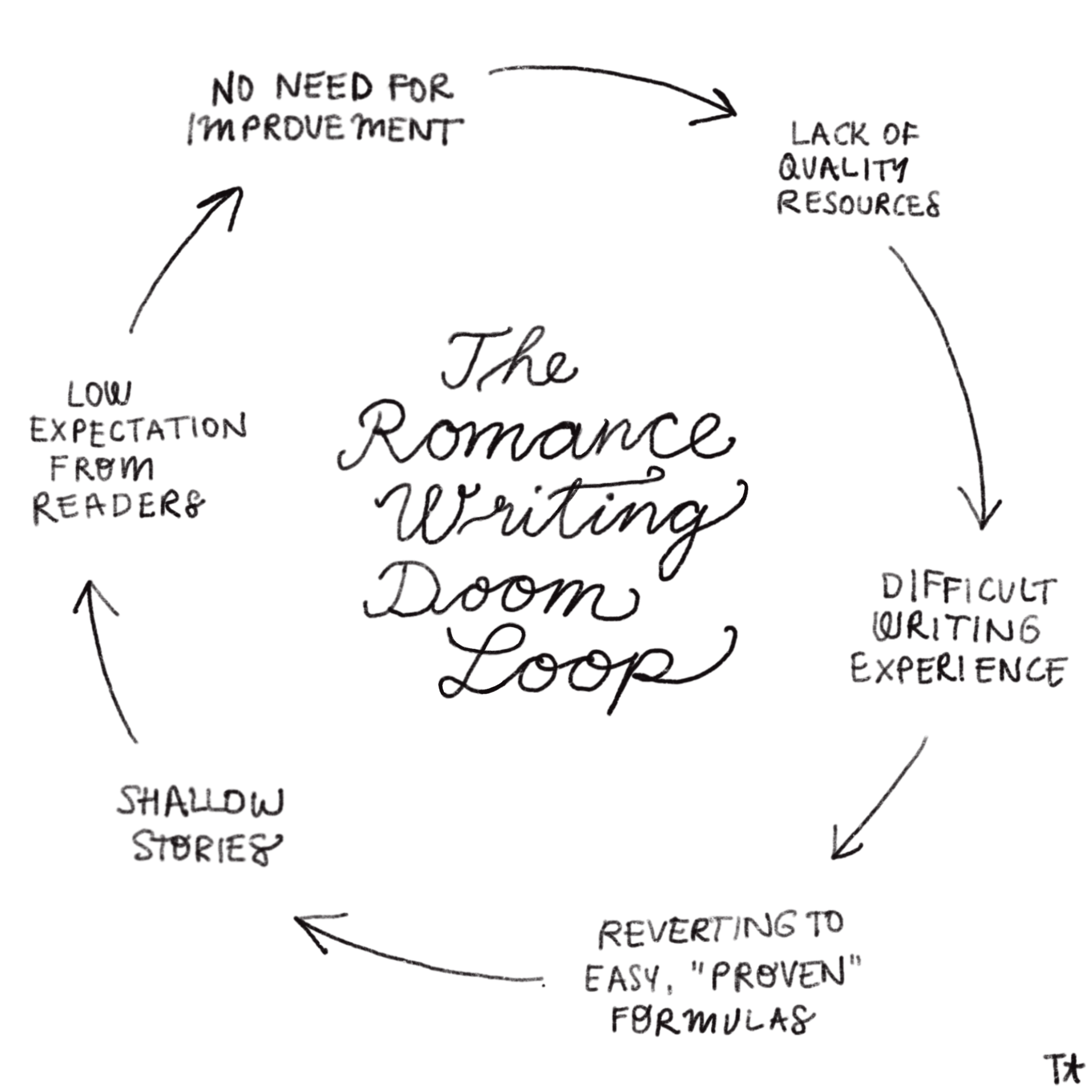
Before you object, I’m not saying this Doom Loop has to be your experience. Some writers sidestep whole chunks of it through hard work, or talent, or sheer luck. But you don’t have to believe every writer is doomed by this pattern to recognise that it shapes the environment we’re all trying to work in.
Because I guarantee you that its individual components are familiar to anyone who’s spent time in romance writing circles: luck-dependent learning, settling for good-enough, reading (or writing) ultimately disappointing stories despite the premise being 🔥, not getting your hopes up, not bothering this time because there’s always a next story, gotta-get-that-backlist-going-at-any-cost-hustle. Nagging doubt, confusing advice, crushing insecurity.
Each turn of the loop erodes not just our confidence, but also what we collectively expect from our craft education.
⚡ ⚡ ⚡
At this point you could throw in the argument that in light of the commercial success of the genre we seem to be doing just fine as is, and—kindly take your pitchfork out of my arse—I too read more than enough romance that fully supports that hypothesis. You could even point out that writing to market so diligently has been a major factor in making romance so popular, and I’d agree with that, too.
But absence is weird sometimes in the way that it doesn’t just leave a gap, it changes how everything else around it behaves. Writers, even our best ones, have become so used to having to operate without a theoretical foundation that we’ve begun to think of our coping strategies as the default process.
Take advice discovery.
It’s not normal that interviews with writers who are promoting their new books are one of our primary vehicles for craft advice. How are you ever going to find that writing insight when the headline is Pen Name releases The Billionaire’s Secret Baby Surprise Wedding Pumpkin Farm? How are we even supposed to know to there’s great advice on character depth in there in the first place?
Don’t get me wrong—I’m glad it the advice is there, I’m grateful both to the interviewer who asked and to the writer who answered, but imagine missing out on it because it happens to be March when you come across that headline, and you’re kind of over pumpkin right now.
You’ve likely experienced that initial thrill of coming across a promising explanation, one that might be a game changer. But while it might be revelatory in some way, more often than not, it’s also a half-sentence at minute fifty-six of a podcast, or scattered all over the Facebook pages of yore. Most of it isn’t structured or comprehensive.
This random stumbling upon is part of a larger pattern where every unexpected occurrence of craft advice tricks us into believing there’s actually more out there somewhere, that comprehensive advice does exist, that we just have to do a better job of finding it. And because we’re convinced it already exists, we don’t invest in better organisation. But because we don’t organise our stuff better, we don’t see how many shelves are actually still empty. The pattern neatly maintains itself.
Take it from someone who, in case it’s not painfully obvious yet, has become genuinely obsessed with this stuff: there’s no there there. Despite the flood of articles that promise to teach you to ‘Master The Art Of Romance Writing’ in all of 800 words, we lack real resources.
And this absence carries forward.
It’s not normal that the bottom line of nearly every piece of craft advice boils down to ‘just read’. There’s something fundamentally presumptuous about elevating reading (or writing) as the only proper way to learn. Aside from the time it takes, it assumes you can recognise any potential craft pattern, when that’s a skill that takes a very deliberate, intentional form of analytical reading, and decades of experience.
‘Just read’ also assumes that we're all innately great at every nuance of craft, and simply need more grit to achieve perfection. But if you’ve ever written anything of substantial length, you’ll know that some things just come easier to you than others. You might be great at crafting punchy dialogue, but struggle with interiority or description. You might be great at planning individual scenes, but lining them up in a story that makes sense feels like a quantum physics problem.
Craft problems vary wildly, and require different strategies and approaches. It’s nuts to expect anyone to work harder at it for longer when creating proper resources would help more writers get there faster. Creative work like writing a romance story involves using identifiable techniques that can be isolated, practiced, and improved. Even the most naturally talented, intuitive artists use learnable methods that can be taught. They’ve just internalised those skills through experience rather than formal instruction.
And look, I’m not arguing we need yet another grand unified writing system, or even that writing is one hundred percent solvable. A strong craft theory should know and convey its limitations, and there’s real growth in sweating tears through the magical bits. Reading and writing are part of that last mile to greatness that no formal craft instruction will ever be able to bridge, that in-between space that no theory can fill. So I would never argue against reading, ever.
But many of us need more.
Many of us are on the ground, struggling to put into practice the techniques, the structures, and the basics.
Theory can’t teach you to fly, but it can give you the competence and technical precision that ensure you at least have a plane when you take off. Self-study solely through reading and writing means you’re building that plane in the air, while trying not to crash.
It can be done. But is this really the best we can give our writers?
⚡ ⚡ ⚡
Other genres have begun to build craft knowledge based on systematic study and analysis because it helps writers articulate their vision more effectively.
In mystery and crime writing, there’s the dual narrative structure that helps writers manage both the story of the crime and the story of the investigation. In sci-fi, there’s Cognitive Estrangement, a framework that helps writers create logically consistent narratives in unfamiliar environments. In fantasy, there’s Brandon Sanderson’s Laws of Magic Systems, which have become hugely influential because they give writers concrete principles and repeatable steps for creating magic systems.
Do they have it all figured out? No. But they’re trying.
In romance, we consistently choose trial and error. We think what we’re doing is normal. It’s not.
Normal looks like this: foundational pieces on the bread and butter of romance writing. Like, you know, yearning, or power dynamics, or forgiveness. What is it? What’s the theory behind it? Why does it work? When does it resonate? Who does it well? How do they do it?
Normal is identifying and teaching the things that make romance tick at the structural level: the push-pull cycles, the building blocks of emotional authenticity, the patterns behind believable emotional escalation.
Normal is gaining an understanding of the psychology of love, how deflection works for different characters, what makes a rejection land differently when it comes from a place of fear versus indifference, and how to make a character’s composure crack believably.
How consistently we block all this stuff in favour of declaring ‘just read’ is indescribably strange to me. But more than that, it’s also actively harmful. Because whether you immediately realised it or not, this fend-for-yourself approach keeps reinforcing and cementing the very inequities that have led so many of us to turn away from organising and community building in recent years.
Before things can get better, it’s time to wrestle with our own uncomfortable truths.
Part III: The True Cost of Doing Nothing
⚡ ⚡ ⚡
If you’re deep in rage against the machine mode by now, I apologise. I promised revolution and giddiness, and neither of those have yet materialised. But here’s a lesson romance writing has taught me over the years: if you want to build emotional payoff and have that sweet sense of satisfaction at the end, there’s got to be some struggle right at the point where you think it’s getting too much.
So let’s take a moment to talk about our community, and what has gone wrong.
Because... things aren’t quite right, are they?
A revolution is only as strong as its community
I’ll readily admit, I’m not the best person to make this argument. I’m currently not participating actively in the romance writing community, I’m not on social media, and this piece holds far, far more opinion than I’ve ever shared publicly. You could call me a hermit and my first reaction would be: How’d you get in here?
While I might not be a pillar of the community, I still feel like I belong to it. I receive conclusive proof of that every time someone uses the appropriate technical terminology for vampire-nun oral sex.
Comment
by u/PastaSauceVampire from discussion
in RomanceBooks
For folks like me, the kind of people that are happier watching others on a dance floor than dancing themselves, acquiring that sense of belonging has gotten more difficult in recent years. There's fewer people out there dancing.
Writers have retreated into private spaces, and I can't blame us. It's a necessity, even if it's also a cock-up. Public discourse has become exhausting and unsafe in ways I don't need to catalogue here, we're all living it. But what we’re left with is a sense of lack: there’s no single place that is busy enough to feel like the romance writing community.
For newer writers, there’s a sense of isolation taking hold. While many experienced or established writers just took their existing support systems private, the resulting fractured sense of community makes building connections from scratch so much harder. A r/romanceauthors post of a user looking to find people to form a writers’ group to combat loneliness garnered 140 comments and became one of the most upvoted posts in 2025. More keep coming.
That's a problem, because our community has always been our most accessible classroom. When we don’t have our most gnarly and helpful discussions out in the open, when not everybody feels like it’s safe or sane for them to contribute, or when they don’t think their contribution is worthy, that classroom slowly disappears.
Private groups tend to have higher-quality discussions, but those insights are unlikely to find their way back to all corners of the community. And every time an experienced writer steps back from the community, their hard-earned knowledge disappears with them instead of living on to serve others.
So this shift from public to private spaces isn’t just about our own feelings of belonging and isolation, which you may or may not feel, and our own access to advice, which you may or may not need, it’s also about knowledge loss and distribution breakdown across the genre as a whole.
Even if you guard your independence fiercely like I do, if you care about the future of romance writing, it’s in your interest to see the community come together again in some way. But in order to get there, we must first acknowledge that whatever our classroom used to be, it was never working for everyone to begin with.
I’ve personally experienced the romance writing community as vibrant and welcoming, kind and generous. Many writers will say the same. Over the years, we’ve leaned hard into romanticising that aspect of ourselves. So much so that we gave our community a brand name: Romancelandia. We actively cultivated a sparkling mythology around the romance genre, and to anyone who will listen, we promote a particularly charming and wonderfully accessible way of conducting our business: everyone can have a go.
But that’s just a story we like to tell.
If you build infrastructure based on myths, eventually what you build collapses under the weight of what it was designed to ignore.
RWA postmortem: lessons from a wreckage
There is nobody that has a better understanding of how advice moves through the romance community than Dr. Christine Larson, a journalism professor at UC Boulder. In her 2024 book, Love in the Time of Self-Publishing, she analyses the informal networks romance writers have long relied on for advice.
 Christine M. Larson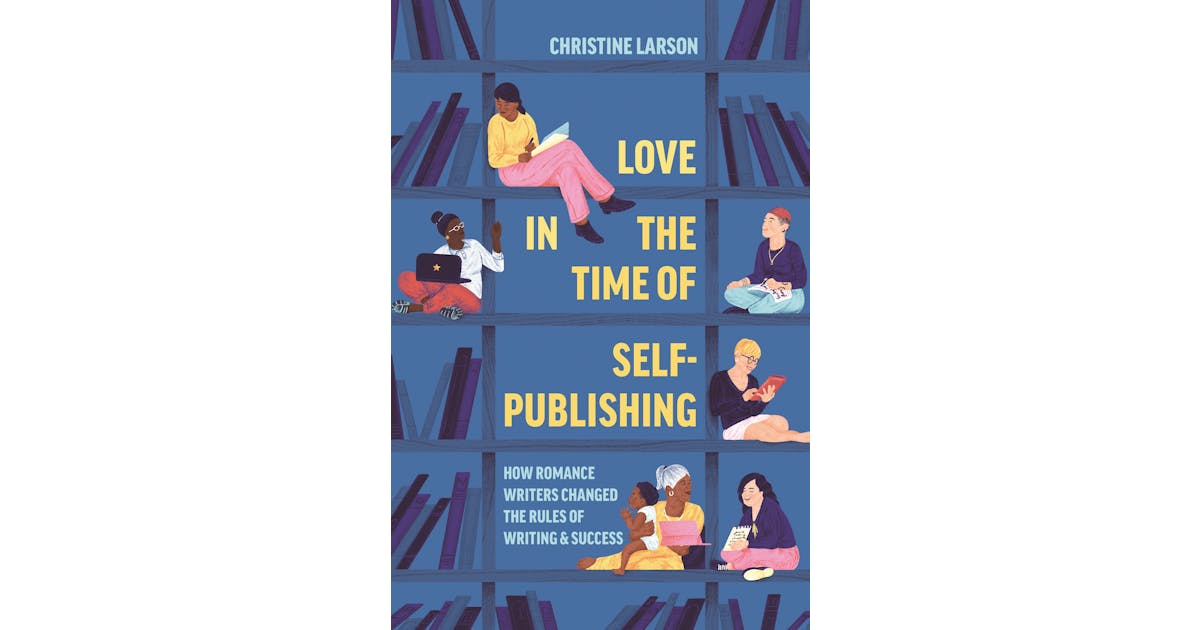
By all accounts, it’s a story of remarkable willingness to provide support, born from recognising that in the face of systematic devaluation it’s ‘us against the world’. Larson calls the support system romance writers have built an open-elite network, because it’s characterised by uncommon access and exchange of information between established and new writers.
Basically, everyone asks everyone for advice, and everyone helps everyone.
Well, almost.
The publishing industry has inequality problems aplenty, and the romance genre is no exception. Throughout her research and often told in their own voices, Larson highlights the unequal access of marginalised writers: to resources, to writing groups, to advocacy, to agents, to deals. It’s a familiar pattern of exclusion.
The industry organisation Romance Writers of America (RWA) looms large throughout. Over the years, many thoughtful voices have charted RWA’s dysfunction and eventual unhappy end. I’ve never been a member of RWA, and I’m definitely not here to revisit that history in detail.
Yet you can’t talk about educational infrastructure in romance without RWA. It played an outsize role in determining what we think of when we think ‘romance’, and its disappearance is severely impacting our craft education.
But it is a fucking minefield.
I have no intention of getting blown up by it, so I’m going to tiptoe around this smouldering wreckage, grab the two useful bits relevant to craft education, and get the hell out again. Cool?
From the outside, it looks like RWA served many writers well, and disadvantaged many others. There are two big lessons to be learned from this, and if we’re looking for solutions to our resource and distribution problems that don’t invite history to repeat itself, ignoring either of them would do us a disservice.
My first observation revolves around RWA facing an impossible task: what the hell was it for? What were (are?) its priorities?
On its website, it calls itself
a nonprofit trade association whose mission is to advance the professional and common business interests of career-focused romance writers through networking and advocacy and by increasing public awareness of the romance genre.
If that kind of tax-mandated gurbled marketing blah-speak leaves you less informed than before, you’re not alone. For her research, Christine Larson interviewed many romance writers who were at one time or another members of RWA. She notes that writers’ needs from the very beginnings exceeded by far what RWA was able to provide. Some wanted craft or business or marketing advice, some wanted help with unfair publishing contracts and platform reps, some wanted genre promotion, others wanted to combat loneliness. Everyone wanted to be heard.
I understand the argument for an organisation like this. I understand the kind of power that comes with having it, especially for an industry and a community that faces as many headwinds as we do. Our collective power is not to be underestimated, and we shouldn’t lose the impulse to wield it.
But you can’t be everything to everyone, not even in romance.
If you’ve got too many priorities, you end up being mediocre at all of them, and everyone is left feeling let down.
And so, my predictable takeaway is that a sprawling industry organisation, while potentially powerful and demonstrably useful, is not and was never the best vehicle for craft education. When it comes to creating and distributing craft resources, focus matters. Priorities matter. Craft deserves to get someone’s full attention.
Having that kind of focus isn’t easy, and you don’t see it often in romance infrastructure: in our blogs, newsletters, publications, communities, and groups, romance runs away with us. We have opinions on Everything (as damn well we should), and slowly our outlet becomes a way to stay in touch with readers, and give craft advice, and review books, and talk marketing, and round up new releases, and interview other writers, and talk about the state of romance, and talk about our cat. As damn well we should.
It’s not wrong to do that, it speaks of generosity and kindness and seeing the gaps. But let me yet again be the arsehole to point out that when we all have this kind of wide thematic focus, it inevitably undermines advice discoverability, it dilutes the power of building expertise and authority, and it can prevent us from going deep because we’re spreading ourselves too thin.
What expertise we have inevitably gets lost, because nobody is building genre infrastructure that cross-references and consolidates all of these insights across our discourse.
Not all of us have to have a singular focus. But there’s undeniably power in it. Imagine if we had a piece of infrastructure that is unapologetically about teaching people the craft of romance writing. Got a marketing question? I feel you, I really do. It’s brutal out there. But darling, this is not your place for that. Got a problem with a character? Cancel your afternoon. Here are resources that allow you to focus on it for ten hours.
That kind of focus is something RWA was never able to build.
But of course that wasn’t its only failure.
The myth of ‘traditional’ romance
My second RWA takeaway is more important in every way: current romance genre infrastructure wasn’t built to be neutral. It favours some romance, and some romance writers, over others.
In Larson’s book and in others’ accounts, there’s often talk about how RWA operated on a rising-tide-lifts-all-boats mentality. I’m not questioning the good intentions behind that; it’s clearly meant to be a generous philosophy, one that highlights the solidarity and camaraderie to be found in the genre. We’re all in the same boat, right?
We’re really not. In pretending that we are, we’re telling ourselves a comfortable lie. The truth is that not everyone has a boat. Not all boats are seaworthy. Some people can’t swim.
The rising-tide metaphor works only if you ignore who built the harbour, and whose yacht gets priority docking. It assumes we’re all starting from the same position of, yes, relative weakness, when in truth many of us weren’t even allowed into the water in the first place.
For years, RWA granted access to the genre selectively by defining it in a way that preserved its supposed heritage. It didn’t discriminate on whether a writer was published or not, but what kind of story you wanted to write mattered. A lot. RWA standards didn’t just declare what romance was; they circumscribed what it could be. In practice, that meant elevating one narrow romance tradition as the ‘real’ thing, and treating departures from it, whether of form, voice, community, or culture, as deviations or aberrations rather than contributions.
No matter where you come down personally in this saga: RWA was wrong to insist on romance being just one thing long after it stopped being true. Not just in its het-only-please-and-thank-you genre definition, and in the astonishing uniformity of the RITA Awards did it become increasingly visible that RWA was fundamentally a product of its time. A time where the word romance meant whiteness if you were doing it the proper way.
I’m sure some people got overtaken by the speed with which the genre and attitudes towards it changed; for others, it seemed like there was an element of reactionary protectionism to it. Some were flat out racist. But for far too long, our largest genre institution clung to an indefensibly outdated construct of both romance and romance writer.
It’s important to recognise that this wasn’t just a moral failing. It was an institutional one. RWA should never have been the arbiter of what romance means. Professional organisations exist to advocate for their members’ interests: negotiating better contracts, providing networking opportunities, facilitating professional development. That’s a fundamentally different job than defining genre boundaries and deciding what counts as ‘real’ romance. RWA tried to do both, and the first role actively undermined the second.
When your organisation’s legitimacy depends on trad publishing’s recognition, when your contests and awards are designed to mesh with industry gatekeepers, you have every reason to define romance success in a way that suits those gatekeepers. Reality required definitions that could expand and evolve with writers’ creative ambitions, and which recognised their identities. RWA’s institutional survival required definitions that would satisfy New York publishing.
Those incentives were never going to align.
An overdue reckoning for RWA has come and gone now. But to me it feels like we started a conversation that was never really finished. Because we didn’t exactly fix things, did we? RWA has lost its credibility, but romance writers have lost the only institution that ever had a claim to speaking for the genre as a whole. Marginalised writers still get a raw deal. Craft education continues to treat one narrow experience of love as the default.
What’s the plan here?
I cannot and don’t want to pretend that I’m speaking for everyone in a genre that’s far too fractured and messy to hold any coherent viewpoint. But at the same time, many of us seem to be waiting for something that’s not going to happen. There’s no institutional cavalry coming in to fix these things for us. Institutional failure persists. And although it is a different kind of exclusion they're now practicing, genre institutions are still filling the void at the centre of our craft with nonsense.
Take the UK's Romantic Novelists' Association. Their current definition of romance doesn’t just erase half our history, it also erases several of romance’s most popular subgenres.
(I'm tactfully ignoring that HEA disclaimer, because romantic fiction and romance are widely understood to be two different things, even though they are doing a poor job of explaining this difference in this unfortunately titled segment ‘What is romance?’)
And I know this isn’t an easy discussion to have. I'm not trying to score equality points here, and I don’t mean to ambush anyone. Many of us will think that’s an arbitrary list, for some others, it might bring a sense of security and order into what feels like a space that is constantly under attack, and constantly changing. But ‘This list is illustrative and not exhaustive’ is the kind of blanket statement that should ring alarm bells for every romance writer. Because what if your idea of love is next?
What do we gain from policing who gets to feel at home in romance writing?
I’m genuinely asking. If it's a sense of security, we’re looking for it in the wrong place. Feeling secure comes from feeling secure in your craft. It comes from knowing exactly what you want your reader to feel, and from knowing how to achieve that effect on the page. It comes from understanding what kind of romance writer you are and what story you want to tell.
Pursuing these exclusionary tactics is not just a question of right and wrong in terms of equality, it's literally a question of right and wrong in the sense of accuracy. We can't build sound craft theory by pretending half the genre doesn’t count.
The reality is this: identity (who you are) and structure (how you tell the story) are not distinct, separate things. They are incredibly tightly linked. So much so that if you enforce one structure as the correct or universal one, you automatically assume there is an identity that fits romance better than another, whether it’s one that's based on race, gender, sexuality, or the psychosexual preferences and kinks that shape what readers find emotionally satisfying.
People who enjoy the things on that RNA list are not broken readers of ‘proper’ romance. They are looking for a different emotional architecture, one where danger and safety twist and intertwine, where morally grey characters are more compelling than virtuous ones, where the fantasy isn't about finding a good partner but about being chosen by a powerful one—or more than one, for that matter.
And I want to be clear that I'm not trying to equate these exclusions. Racism and discrimination aren’t the same thing as telling someone their kink isn't welcome. One is an existential denial, the other is a disagreement over content. The harms are of vastly different magnitudes. But the mechanism is identical. And we keep reaching for it.
Our infrastructure has not evolved. While we haven't even properly begun the overdue work of building a more inclusive foundation, we're already off excluding others in the same entitled attempt to define what romance really is. Of course romance can be Black. Of course it can be gay. It just can’t feature dubcon, you know?
This kind of gatekeeping is a recurring loop. It's genre muscle memory, and we’re constantly flexing. It’s keeping us trapped in a cycle of forever deciding what kind of romance is proper and virtuous and moral enough to belong, while we ignore the fact that these definition determine not what but who gets to count.
We are far too cavalier with this power.
And look, I'm not naive. As romance writers, we’re not going to solve racism and discrimination today. But if you look at the history of how romance writers have educated themselves, these systems are almost entirely our own. We made them. This is one of the few areas where we actually have enough agency to clean up our own house. We just have to want it. It’s not enough to hope that our harbour reshapes itself over time. We have to actively rebuild it.
We should start by confronting something—out loud—that we’ve treated as neutral fact in our education for far too long:
Romance isn’t white at its core.
If we want the genre to thrive, clinging to that obvious myth in the name of tradition isn’t going to get us there. Teaching everyone how to write romance with ‘universal’ (i.e. white) appeal hasn’t yielded great results. Not for stories, and certainly not for people.
If there is only one thing you take away from this, let it be this: if we make a deliberate move to view the genre’s supposed fundamentals as flawed ideology rather than intrinsic, the entire project of craft education can shift to become more helpful for more people.
We can stop asking How do we teach everyone to write romance correctly? and start asking How do we help each writer develop their own romance instincts into something commercially and emotionally viable?
We can stop the pretence that there’s one correct way to structure desire, one correct set of characters, one correct emotional arc for falling in love. There isn’t. There are lots of valid approaches. If you like the traditional ones, great. If you prefer others, great.
And yes, applying this new kind of neutrality—or freedom—in our romance writing advice is unquestionably harder. It’s not something we’re currently doing. But it’s something we can figure out how to do, because it is squarely within our control and our interests.
Especially when you consider the opportunity costs of not doing it.
⚡ ⚡ ⚡
I believe very deeply that everyone should have a fair shot at writing whatever the hell kind of romance they want, and yes, that includes the stuff you don’t personally see as belonging to the genre. But even if you don’t feel the same moral imperative, I want to take a moment to show why levelling the craft playing field is at least in your economic interest.
When writers build on their authentic strengths, they often discover an entirely new set of readers who’ve been underserved. Poly romance, horror romance, later in life romance—these aren’t just niches. They’re markets that grew because writers brought perspectives and priorities that the established craft conversation had completely ignored.
If we continue to exclude these writers from shaping craft theory, we don’t just lose their stories and their perspectives as innovation engines. We lose entire reader populations who never find their way into romance at all. We lose career opportunities and leave revenue on the table.
The bottom line is simple: romance accommodates far more variety than our current craft advice suggests. It’s already true, so why fight it in the name of tradition? If you love that tradition, like I do, write a traditional romance. Your readers will thank you. And then they might read an MFM robot space opera romance while they wait for your next story, and a sapphic paranormal romance, and something with an anatomically adventurous badger. So what?
Reorienting craft education towards that kind of openness isn’t a roundabout attempt at charity or social policy. It’s basic competitive strategy that enables more writers to develop something unique to them that others can’t easily replicate. It’s recognising that craft theory is genre infrastructure in a literal sense. It’s roads and bridges, power lines and waterways. Building all our educational roads so that they lead only to that one white comfort destination is an insanely stupid business decision.
More people will take more trips if they can go to more places.
That’s how we grow the pie for everyone.
Comment
by u/Inappropriate_Pen from discussion
in RomanceBooks
But there's work to do before we can get there.
Which brings me to, well, you.
⚡ ⚡ ⚡
Despite the strange status quo, I would bet my unpublished romance drafts (a thought so horrifying I had to check they’re still buried in that inconspicuously named folder) that our community is the answer to all these problems.
Frankly, it has to be.
One person alone can’t possibly reflect the breadth and depth of what’s really going on in romance craft today, even if that person happily gobbles up everything on the all-you-can-read romance buffet.
So I need your help.
Over the past few years, I’ve worked through a ton of takes on the romance community. It might sound cheesy, but what I’ve learned is that anyone who underestimates romance writers does it at their own risk. Our community has real problems, but far more than in other genres, it aspires to be a kind and caring place that takes care of its own.
Importantly, it’s a place where we don't wait for opportunity, because nobody is going to hand it to us. We’ve learnt to create it.
It’s time to do so again.
To me it felt like we were caught in a holding pattern these past few years. We burned it all down, and we were right in doing so, but whatever we’re now left with is fucking weird, and uncharacteristically aimless. Everything is kind of subdued, and that is not a colour that suits us. I don’t know about you, but I’m ready to snap out of it. I’m ready to get to work.
One take amongst the volumes of infighting and the professional tension and the heartbreaking let-downs around RWA has stayed with me more than any other, perhaps because it so closely mirrors my own feelings about our community. In her book, Christine Larson cites romance writer Jodi Thomas. The 2010 quote sums up what RWA could mean for a writer:
“At the time I didn’t know many writers and when I hit RWA, I felt like I’d been an alien all my life and found the home planet.”
I believe that feeling is still real, even if the institution couldn't sustain it.
We’ve watched our world burn for long enough now.
Let’s rebuild our home planet.
Part IV: Fuck It Let’s Fix It
⚡ ⚡ ⚡
If you feel like you’ve started reading this decades ago, I’m with you. At times, it felt like my brain was actively plotting against me. There was a whole section on the anatomy of Brussels sprouts in here at one point (don’t ask).
But we’re in the home stretch now.
We’ve seen that romance theory lags way behind the genre’s complexity and commercial success. Because the broader culture delegitimises romance, we’ve been caught in a doom loop, cycling between low expectations and lack of resources. On top of that, the community has fragmented and moved into private spaces. Even if we had resources that reflected all corners of romance, we currently have no means of distributing those insights effectively to people who are looking for them, and no means to preserve our knowledge for future romance writers.
But what if we just created those means?
What if we built and collected resources that work for brand new writers as well as for writers who have been at this for decades? What if we made it easy for everyone to chime in with their takes, but don’t demand of them what they cannot or don’t want to give?
That would be revolutionary.
And long overdue.
A romance revolution blueprint
The plan I’ve hatched is rather idiotically straightforward. I’m building the library for romance craft education our genre has never had.
It will be free and have two core functions: the first one is to collect and contextualise every useful bit of romance writing advice I or others can find. That means I'll gather it, organise it, and make sure you can find it when you need it.
But this is not simply aggregation of Everything. We’ve wasted enough time mining the internet for gems. We’ll have the jewellery store version of advice now, please and thank you. So there will be active curation, according to principles I’ve discussed in this piece. These resources should prioritise real understanding, aid concrete problem-solving, and teach not just the what, but the how and why, too.
So far, so ambitious.
The second function of the library will be research. We haven’t flexed our theory muscles in a good long while, but I bet you anything that there’s a romance research renaissance coming our way. My contribution to it will be original theory creation. I’ve held on to my nerdy analytical opinions about the science of hotness for far too long.
My plan is to release these proposals in ‘beta mode’ first, so that they can be tested, discussed, and amended by the community. While that won’t make them perfect, we have a higher chance of ending up with a more well-rounded version of what we need. At least until someone else comes along and makes an even better version of their own.
 Greta Clarke
Crucially, none of these resources will dictate what romance has to be, or police what anyone wants to write. They’re meant to enable every writer to apply romance craft knowledge to their own vision in their own way.
Welcome to Trope Theory.
⚡ ⚡ ⚡
I believe there’s true value and flexibility in something that isn’t a static resource done once by one person, but a curated collection that is being actively worked on, refined, tested and improved in the community. We’re a dynamic genre, our resource base should reflect it.
There’s also a collective power that comes with being able to point to a resource like that, saying here’s how we think this works. We, the humans who love reading kissy stuff and who read enough of it to feel and think our way into why it works so well for so many. Writers and agents and editors and readers and scholars and everyone who wants to build romance theory from the ground up, rather than from the scraps of a broken system.
But above all, there are vast individual benefits for all the romance writers out there who are struggling to find technically sound answers to their answerable questions. The time we’d save alone could be revolutionary, to say nothing of the craft and confidence boost that would come from being able to freely access our collective insights on romance craft excellence.
I can’t overstate how much of a game changer this would have been for 14-year-old me, trying to figure out how to get started. The wonderful thing about it is that it would still be a game changer for me today. Because after all this time failing at romance writing, I still discover hitherto unknown ways to screw up a story.
But I’m not naive enough to pretend this solution is all rainbows and unicorns. When building a knowledge system like that, a lot can go wrong. The devil is in the details, and execution is everything:
1) Curation is necessary
If you’ve been on the receiving end of exclusion in this genre, you have every right to be sceptical of any new forms of gatekeeping. Curation means making choices, and choices reflect the identity of who makes them.
In that case, me. (Hi.)
Despite those very real, very understandable concerns, I believe some form of curation is needed, for a time. Without curation, you’re spending more time looking for real answers than fixing your problem. I’ve complained at length about the lack of solid advice, but another way of looking at it is that a deluge of subpar advice obscures the quality bits right now. Or that the loudest voices drown out the quieter, helpful ones that don’t necessarily participate in writers-marketing-to-writers hustle culture.
Throughout this piece I’ve provided some (ahem) context to my thought processes as to which kind of content I think should be elevated. If you’ve followed along, they’ll be familiar by now, but it’s important to spell them out clearly:
- Depth over Surface: I will prioritise recommending and creating resources that go beyond the what to explain the how and why. Good theory illuminates choices and develops judgement.
- Romance-Centred: I will prioritise recommending and creating resources that have been built from the ground up to reflect romance’s unique characteristics and challenges, with an eye towards preserving its quirks.
- Excellence is Everywhere: I will include as many voices, perspectives and opinions as I possibly can, with an understanding that technical brilliance belongs to everyone, and that many powerful craft innovations have come from those who have been forced to write outside the traditional rules.
- Practical Theory: I will prioritise resources that help writers solve concrete problems on the page. Sometimes you need a quick blueprint, sometimes you need deep understanding. Both are valid, and good theory accommodates both. I’m not interested in creating rigid systems that serve themselves rather than the writer.
- Anti-Hierarchical: I won’t privilege subgenres, heat levels, publishing paths, experience or formats over one another. If it clearly illustrates a principle, you’ll find me discussing fan fiction, poetry, songwriting, screenwriting.
- Free: Non-book contributions must be freely accessible and not paywalled. I won’t point people to paid courses or hard upsells. There’s nothing wrong with wanting to be remunerated for your teaching work or your insights, but foundational genre theory should be accessible to all romance writers.
So, call me the curator. (Also, call me with your museum romance recs. That whole sexy dusty archive vibe is definitely A Thing for me.)
Is this system perfect? No, of course not. It’s a minimum viable solution, a first step towards slowly improving an unsustainable situation.
It hinges on one person not being a dick. But it beats having nothing at all, and laying out a set of transparent principles at least lets you know where I stand conceptually. I’m committed to iterating and improving as we go. And here’s a bright spot: once there’s a critical mass of accessible content, curation becomes no longer necessary.
Essentially, I’m working on making myself obsolete.
And if you think I get it wrong on the way there, there’s absolutely nothing preventing you from doing this exact same thing, but better. I’d be your biggest cheerleader.
2) Education must be free
This isn’t one of those projects that chases paid subscriptions or locks content behind paywalls. Yes, I’m aware that’s not how the world works anymore, but guess what, I’m stubborn and determined, and over my dead (or rather, poor) body will I monetise our fears and insecurities. We need one Good Thing, one goddamn thing that for once isn’t trying to screw you over—unless it’s to show you step by step how it is done in a really crafty way.
If Trope Theory ever needs funding to sustain itself, I’ll figure that out transparently and without compromising access. But that’s a future problem. Right now, the problem is that nothing like this exists yet.
3) Community is paramount
I cannot stress how much I don’t yet know about the craft of romance writing. There are people who are vastly, vastly more knowledgeable than I am. I hope they won’t see this as a cynical power grab, but rather as an opportunity, an invitation for collaboration.
Whether that’s you pointing me to your own dissertation on Viking romance, or sharing why a particular resource finally made grovelling click for you, or arguing how my take on sexual tension is wrong—I want to hear it. If you’ve got your own freely accessible take on a particular craft problem, I will do my very best to get as many eyeballs on it as I can. This way, you’ll continue to be the owner of your piece, and you have complete editorial control over your thoughts, but your insights won’t be swept away when the discourse moves on. It can be found by people who need it, people who know they can find this kind of information here.
Projects like these live and die with community participation. I will put in the work, but I hope you will put out the word.
If you’re interested in actively helping or sharing your perspective, or want to pass along random half-cooked bits and pieces of theory, or know of helpful links, or if you’ve just read a quote that executes a craft principle so beautifully it moves you beyond what should be reasonable on a Tuesday afternoon, please accept my open-ended invitation to reach out.
 Greta Clarke
No need to be a writer, either. I’ve not mentioned nearly enough throughout that romance readers have some of the most nuanced, thoughtful discussions of the genre. You’re welcome to participate. We need your perspective.
4) The case for leaving things alone
Before we fire up the wrecking balls, I want to clarify one last point.
Despite the impression you may have gotten from my use of dickish phrases like success factors, I’m not arguing to change anything at all about anyone’s stories, and I’m not setting out on some righteous quest to ‘fix’ romance. Difficult as it may be to accept for anyone who feels like standards have eroded, romance doesn’t need saving and it doesn’t need literarification.
Building craft knowledge that accepts that premise will help you finally put a goddamn name to the effect you’re after, and show you exactly how that effect can be replicated. But it’s not meant to override your instincts or question your ambitions.
Which, speaking of...
Have you considered starting your own revolution?
I've dawdled a good year longer than necessary with this piece, not only because attempting to present the layers of fuckery here in a somewhat orderly way was surprisingly difficult, but because shiny new things keep distracting me.
Things like how romance conflict really works, and what would be the simplest, most efficient system to teach it while preserving its inherent complexity. A practical framework on how to establish solid tension dynamics. Missing taxonomy. Sentence-level craft advice. An epic side quest to square the circle that is the enemies-to-lovers trope, just because I was curious to see if it can—or should—be done (spoiler alert: it should absolutely not be done, it is a flaming hot pile of garbage).
It is so exciting.
I have never worked on anything that is so hard yet so fulfilling, and you know what, as a parting gift, I’ll spare you that dick joke.
🍆
There are so many of you who have taught others for so many years. So many who have passed on their knowledge when we’ve just seen proof that there is zero systemic incentive to do so. I feel a responsibility to honour those efforts and to do them justice.
So, with respect to all who’ve come before and bubbling excitement for what’s ahead, there’s really only one thing left to say:
What’s your manifesto?
I mentioned our home planet earlier. Even if we manage to build Trope Theory into a cathedral of a craft library, there are still so many other areas on that planet that need better infrastructure. Vast stretches of land, waiting, begging, to be explored:
- I see several independent, inclusive, expansive industry award systems that don’t suck, endorse liberally, help with building a robust criticism culture, and improve legitimisation long-term.
- Making romance marketing knowledge more structured and accessible, and generally less of a nightmarish hellscape for romance writers, needs the attention of a fleet of brave souls.
- Self-promotion desperately, urgently requires some innovative thinking and perhaps a dedicated platform (but ffs include the fanfic people, too).
- While we’re at it, where are the romance innovations in ad tech, so that writers can pool ad spending smartly?
- Romance is systematically under-acquired by libraries all around the world. This isn't just bias; nobody’s doing coordinated advocacy. That one is worth obsessing over.
- Let’s take a crack at making serialisation a proper thing again, romance-style.
- Romance screenwriting needs you. Badly.
- Someone must figure out YA classification. It’s a mess. Nobody’s taking responsibility.
- And where, for all that is good and holy, is the Romance Review of Books? A literary publication that takes our craft and our culture seriously but not itself, and brings out the best in us, in all its variations? If enough people subscribe, we might even be able to (gasp) pay people for their critical thoughts. Romance reviewers should revolt, y’all.
- And don't even get me started about what could be done if we actually started gathering our own data instead of ceding that territory to the algorithm death star. Right now it’s like we’re being blindfolded the moment we attempt to go there. And we don’t mind that per se, but you had better fucking ask us first.
I’m talking about relentless focus. I’m talking about romance-first solutions that come from within the community and make the world suck a little less. I know you people. I know you see the gaps. I know there’s a revolutionary, a rebel, in all of you.
Sometimes literally. 😙🤌
The point is, let’s go.
If I can help in any way, or if you just want to say hi or share your thoughts: please reach out. I mean it. My name’s Greta, I’m a real human being, and I love thinking out loud about the romance genre.
So that's what I’ll keep doing.
And since I kind of got us all into this mess of Knowing About All The Problems With Romance Writing Education, my first order of business is providing you with the proper means and tools to help clean it up, should you want to.
To that end, I’ve gathered some context about what we should know about craft theorising, what a helpful bit of theory actually looks like, and how to make one yourself. After that, we’re going to talk about the state of general writing advice, because turns out it’s a separate but equally infuriating nesting doll of fuckery that reaches all the way back to antiquity—or as we romance writers like to call it: The Golden Age Of Men Wearing Nothing But Sheets.
Yes, I will shamelessly attempt to make it worth your while.
And then, I want to start building the theory of romance writing.
You in?